Thermography – Potential energy savings for the building industry and house owners
Thermography is a non-destructive testing and measurement method based on infrared radiation which is invisible to human beings. It has become firmly established in the construction industry, because it enables conclusions to be drawn about heat insulation and possible structural defects, such as thermal bridges, using meaningful thermal images.
Outdoor thermography
Outdoor thermography enables a fast energy assessment of the whole building shell. It provides an overview of the heat released by the outer wall and is therefore predominantly used for locating weak spots, such as
- thermal bridges
- leaks
- insulation defects
- moisture damage in the building shell
Outdoor thermography provides a quick method for detecting possible structural defects. It also enables the identification of timber frames coated with mineral plaster. The infrared image also reveals areas where plaster is breaking off. Thermography is ideally carried out around two hours after sunset.
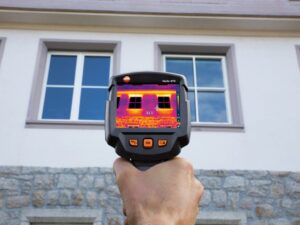
Testo Thermal Scanner thermography finding energy loss in buildings
Locating thermal bridges
Thermal bridges are among the heat-related building defects that occur most frequently.
Thermal bridges are deemed to be localized areas through which heat is more rapidly transported to the outside than through the other components.
They firstly cause a great deal of energy loss and secondly condensation, which may in the end lead to mould formation.
Thermal bridges frequently occur on
- balconies
- window frames and lintels
- hollow ceilings made of reinforced concrete
- non-insulated components.
Indoor thermography
Indoor thermography involves thermal images being taken of the interior of a building or of components. The advantage of this process is that the same temperature prevails over a longer period of time indoors and also that the external influences of the weather require only limited consideration. Indoor thermography can for example enable:
- insulation damage
- leaks in pipe insulation
- underfloor heating pipes to be visualized in a targeted way
- locating of moisture damage
- mould infestation
Many thermal weak spots can only be detected using indoor thermography. In addition, other measurements, such as the differential pressure measurement method (also: blower door test), are substantiated by indoor thermography. Indoor thermography is used in a much broader range of areas of expertise.